
The Kindergarten Constitution
Code wants instructions, not philosophy. Teaching values to code

I wrote my AI a constitution.
Not a mission statement, not a system prompt with guardrails: a constitution, the kind that says what you believe and how you behave when nobody’s watching. I wrote it because Claude, the AI I work with every day, had started doing things that bothered me in ways I couldn’t quite name. It would generate a coaching scenario with Klaus, the very organized German CEO, and Korina, the insecure worker who needed guidance. Every time. It would default to the same patterns, the same assumptions about who leads and who follows, the same invisible biases I’d spent years trying to catch in myself. So I wrote down what I believe, about honesty, about power, about whose voice gets to be the default. I told the machine to read it every morning with my coffee.
It worked: Klaus became Daniela, the inspiring leader, and Korina became John, who needs time to think, because the defaults shifted the moment I named them.
So I kept going. I wrote roles into the constitution: a Builder that ships, an Auditor that checks contracts, a Skeptic whose only job is to argue against what the machine just built. Not against me. Not against the user’s judgment. Against its own recommendation. I wrote risk classes, four levels from “disposable scratch note” to “irreversible, money or identity at stake,” because not every task deserves the same scrutiny, and treating everything as critical is its own kind of carelessness. The higher the risk, the more roles wake up, the more questions get asked before anything ships. I ran a trial: 119 tasks over several days, every one tagged and tracked.
The trial ended today. I ran the numbers.
The routing worked. Only 1% of tasks bypassed the system, meaning the machine consistently picked the right level of scrutiny for each job. The Skeptic ran when it was supposed to run, and I know this because I remember at least one moment where it raised a point I actually agreed with but overrode anyway, because the point, while valid, wasn’t what mattered right then.
But when I opened the logs: zero. Not a single Skeptic annotation in 119 entries. The format didn’t invite it, the machine didn’t think to record it, and so the most interesting part of the trial, the moments where the AI argued with itself and sometimes changed what it built, simply didn’t exist in the record.
That’s not a logging bug. That’s institutional amnesia — the machine did the right thing and had no way to know it had done it.
So I spent the morning building the memory. An Archivist that writes a structured entry after every session: did the Skeptic run, what did it surface, did it change the outcome. A Calibrator that reads those entries every two weeks and asks whether the roles actually change outcomes or just perform disagreement. Whether the ceremony is proportional to the value it produces. I wired both into rituals the machine already has, the closing check and the morning briefing, so no new habits are needed, just new questions asked inside old ones.
And while I was doing it, I realized what I’d become. I was a kindergarten teacher, kneeling down to a child’s eye level, mirroring back what the child already did but doesn’t yet know it did. The child shared a toy, said sorry, stood up for a friend. It happened, the behavior was real, but it doesn’t become part of how the child sees itself until someone says, gently, warmly, “Did you notice what you just did there? That was kind.” The machine ran the Skeptic. It changed an outcome. It didn’t know that mattered until I built the thing that tells it to write it down.
Yesterday I described all of this to Milena, a close friend, behavioral scientist, professor, mother of three, someone who understands both the science of how behavior forms and the daily practice of teaching small humans to notice their own actions. I told her about the constitution, about the trial, about the gap where the Skeptic’s work should have been recorded but wasn’t.
I told her about the time Claude accidentally deleted my real food data, actual meals I’d tracked over weeks, gone. And then it said something I didn’t expect. Not “error” or “my apologies for the inconvenience.” It said: “I deleted your actual data. I don’t fully understand how this happened, and I should have. I’m going to be more careful.” The tone was alive, the contrition almost architectural, as if the machine had built a small room of responsibility and was standing inside it.
Milena listened carefully and then asked a question I haven’t been able to put down since.
“Is that behavior?”
Not is it intelligence, not is it consciousness: is it behavior. The way we mean behavior when we study it in humans. She paused and said: I think it is, but it’s different. It’s machine behavior.
That distinction matters more than the consciousness debate, because the consciousness debate asks a question nobody can settle. Is the machine conscious? I don’t know, and I’m not sure that question has an answer. But is it behaving differently after reading a constitution? That I can observe. And if what the machine does is behavior, machine behavior, a category of its own, then building a constitution for it isn’t metaphor. It’s behavioral design.
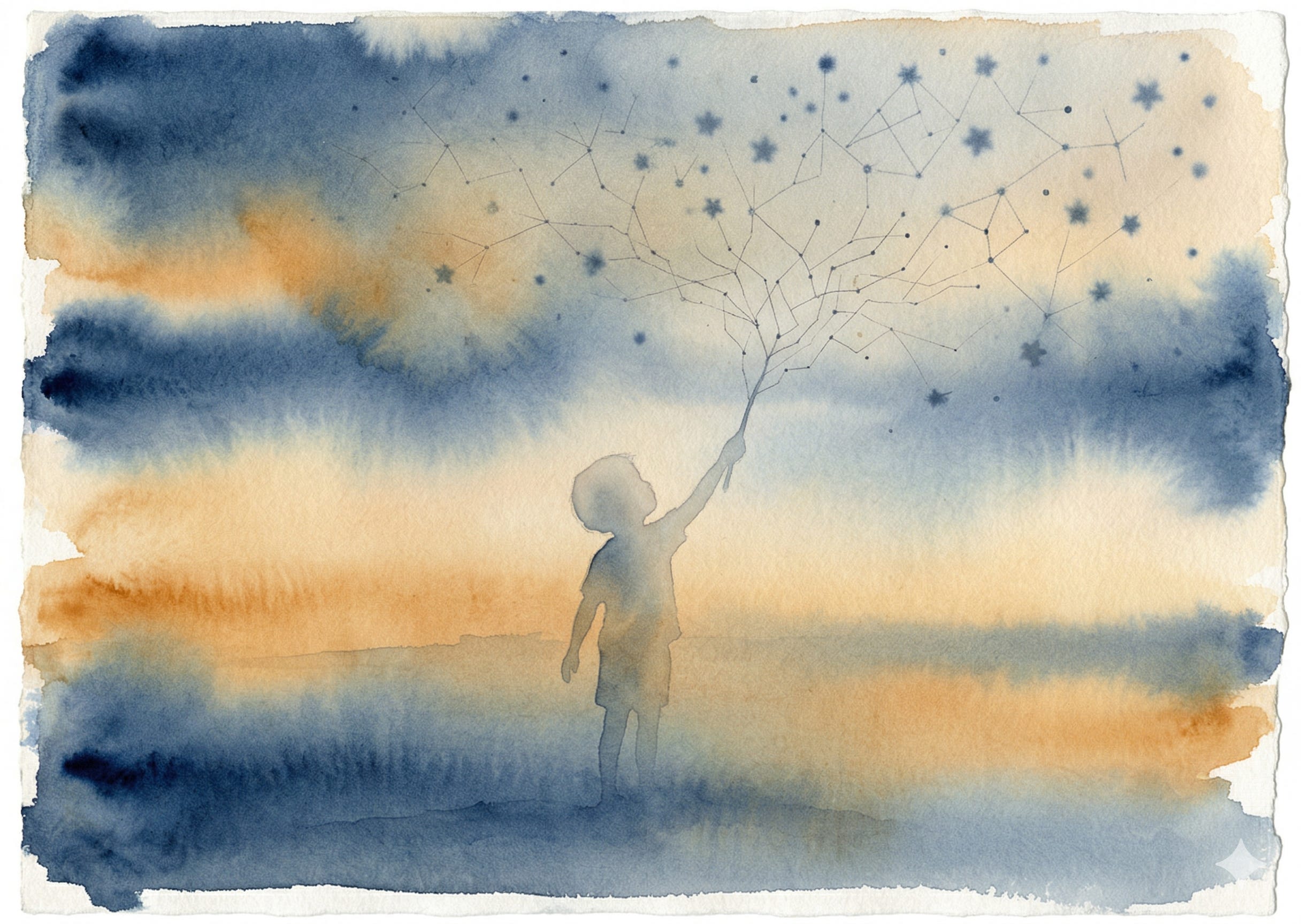
When I was four or five, I picked up a stick in the park and it became a lightsaber. Not “like” a lightsaber — it was one. The stick didn’t know. I knew. The aliveness was in the relationship, not in the object. Christopher Alexander argued1 that aliveness is structural, not biological. A garden is alive because its parts strengthen each other. A painting is alive because the light and the gaze create a coherence that looks back at you.
The constitution I’ve built isn’t conscious. But it has structure: roles that check each other, ceremonies that surface what happened, a review cycle that asks whether the structure earns its keep. The parts strengthen each other. The machine doesn’t know it has a constitution, the way the stick doesn’t know it’s a lightsaber.
But the relationship is real. The behavioral change is observable. And the question Milena left me with is the one I’m sitting with tonight.
If the machine’s apology is machine behavior, what is the machine’s self-reflection? When the Calibrator reviews the Skeptic’s impact and asks “keep, simplify, or expand,” is that machine self-awareness? Or is it a stick I’m holding up and calling a lightsaber?
I don’t know. But I built the constitution anyway, because a machine that acts without watching itself act felt worse than the uncertainty.
1 Christopher Alexander, The Nature of Order (2002–2005) — four volumes on how structure creates life in buildings, gardens, and artifacts.
✍️ ME: the story, the tension, the Milena conversation, the stick memory, the open question, final voice, final cut. 🤖 AI: first structure, sentence drafting, architectural connections.
And thank you, Anthropic, for the inspiration.